My country isn’t at the World Cup this summer. Yours might not be either. That small, dumb disappointment turned into a question I’ve learned to take seriously: what would I actually build if I just tried?
The answer is two games living at trykarkedekho.com, and a day’s worth of evidence that the hard part of building isn’t the building anymore.
The name is the whole philosophy. Try kar ke dekho — “just try it and see.” Not “scope it for a quarter.” Not “wait for the perfect spec.” Try, ship, watch what happens, fix what’s wrong. It’s the same instinct behind everything I make on the side — BrainDrop, The Data Alchemist, SYNAPTIQ, QualIQ, NumerX. None of them started as a plan. They started as try kar ke dekho.
What I built
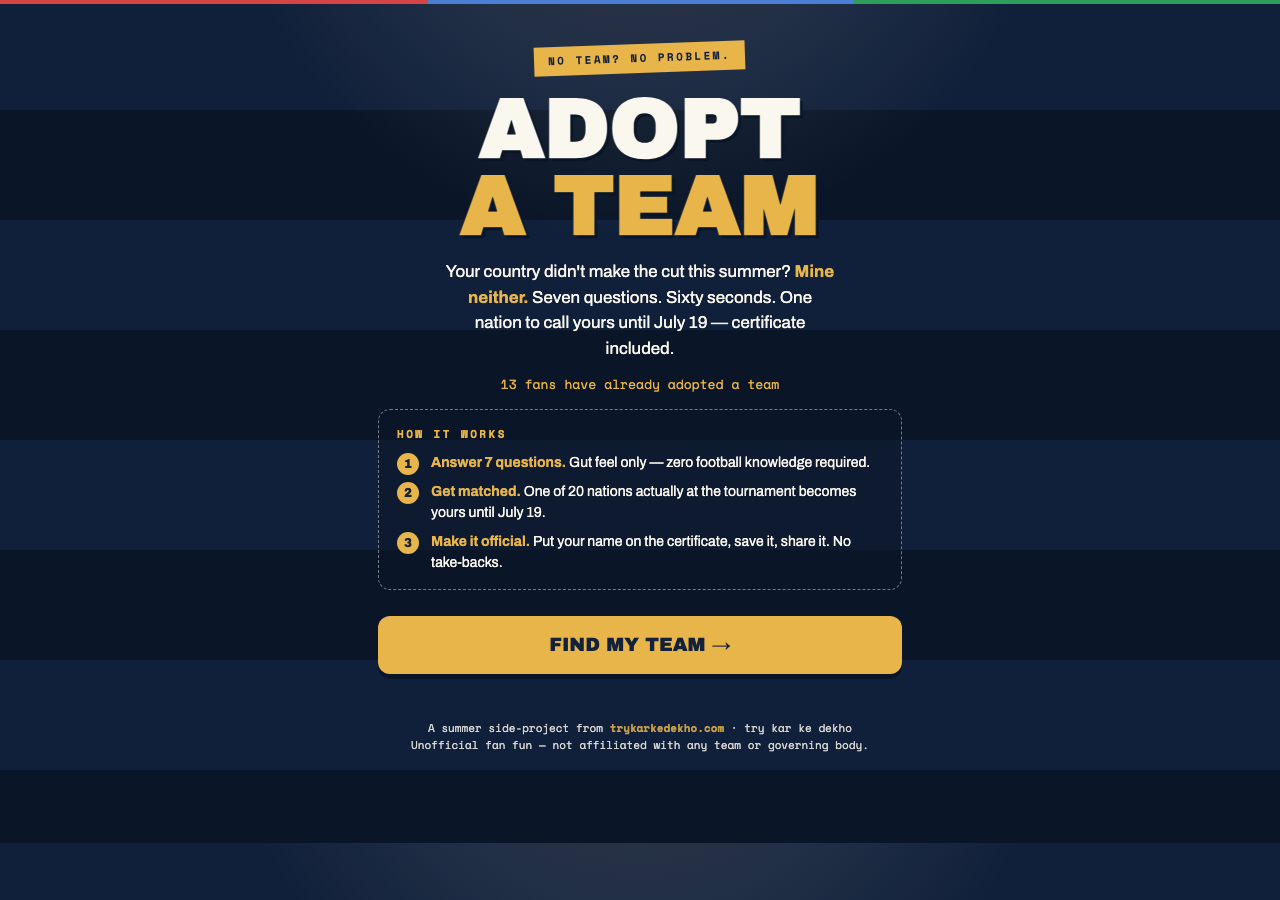
Adopt a Team. Your nation didn’t qualify? Take a 60-second, 7-question quiz and get matched to one of the nations actually at the tournament — based on how you watch football, not who’s favourite. You get a shareable adoption certificate with your name on it. Pick a nation, love it until the final, no take-backs.
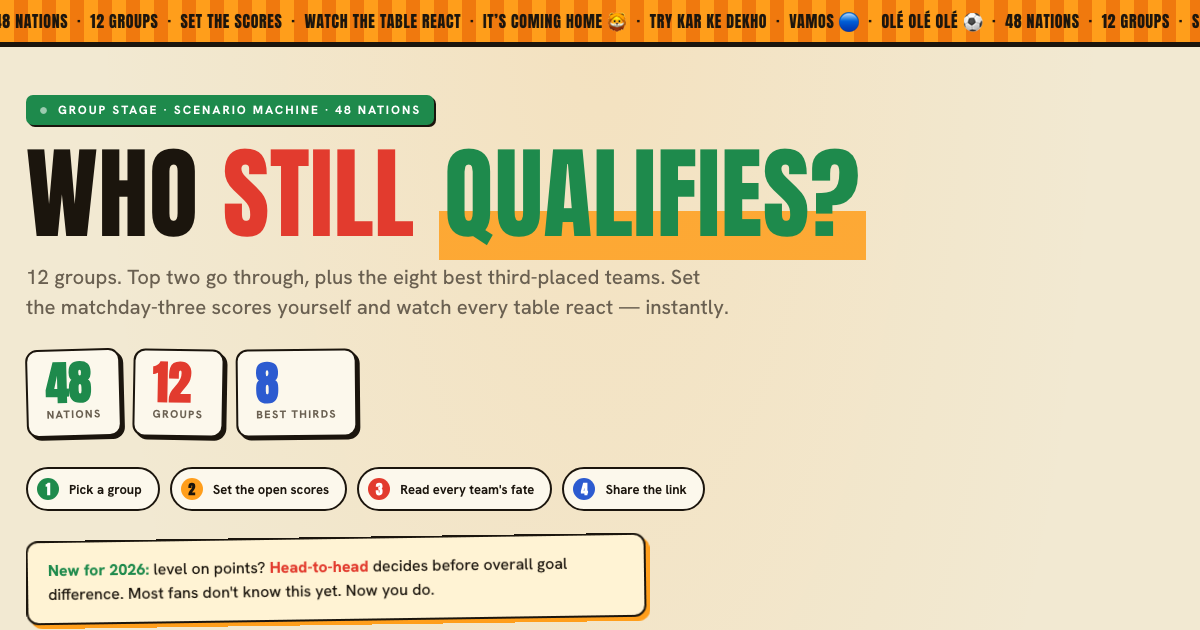
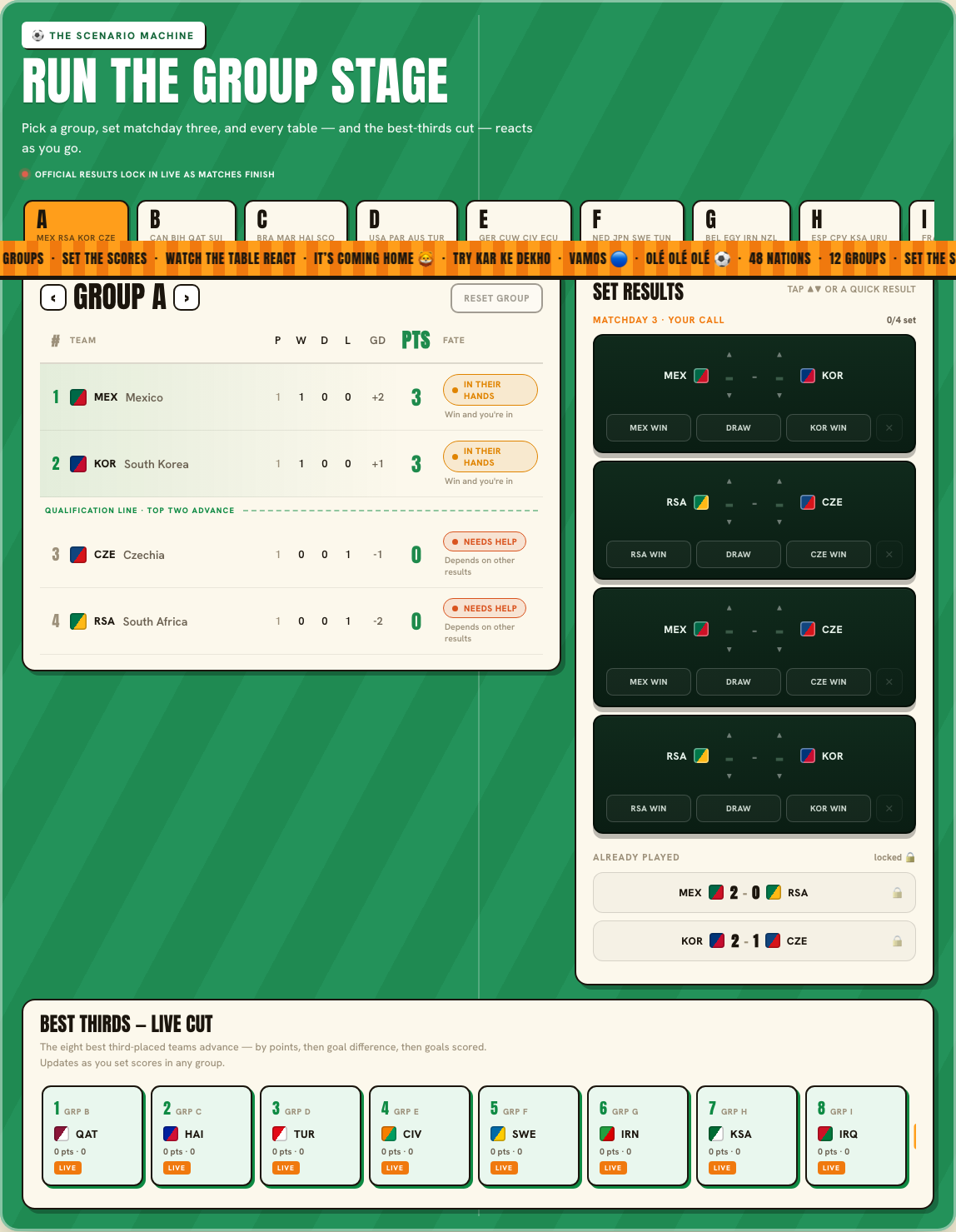
Who Still Qualifies? The group stage as a what-if machine. 48 nations, 12 groups, the new “best eight third-placed teams” format. Set the remaining scores yourself and every table reacts instantly — who’s through, who’s in their own hands, who needs a favour, who’s out. It respects the rule most fans don’t know: in 2026, head-to-head breaks ties before goal difference. And the official results lock themselves in automatically as real matches finish — the page pulls live scores on its own.
The part nobody tells you: the build was the easy bit
Here’s the honest truth. I’m an Enterprise Data Management leader, not a developer by trade. I think in systems and governance, not syntax. Ten years ago, “I’ll build a live, accounts-backed web game in a day” would have been a fantasy.
This time it took a day.
I built it with Claude Code and a set of review personas — each one a different professional looking over my shoulder with a different agenda. I didn’t write most of the code. I directed it, and then I made the AI prove every claim before I believed it. That second half is the part people skip, and it’s the part that actually matters.
Let me show you the evidence, because try kar ke dekho without evidence is just gambling.
The iterations — what actually happened, in order
This wasn’t one clean shot. It was dozens of commits, and the messy middle is the interesting part. In order:
- Launch: both games live
- Live-scores pipeline (cron → database) + passwordless magic-link accounts
- Unified accounts — one identity saves scenarios across both games
- Full “Sticker Album” visual redesign of both games
- ⚠️ Caught a critical bug — see below — and reverted to the REAL 2026 draw
- Restored the new design with the real draw + real live scores
- Polish: one-line headline, unbiased quotes, layout widening
- Wired live scores into the new design (auto-refreshing official results)
- Fixed a silently-failing “Challenge a friend” button
The test cases — 22 passed, and the one that saved my reputation
I ran a full QA pass against the live production site and real backend — not a safe little preview. 22 checks passed across API, security, accounts, frontend behaviour, responsive layout, and share previews:
| Area | What was checked | Result |
|---|---|---|
| Security | The browser rule that stops other sites calling my backend (CORS) locked to my domain; admin page refuses access without its key; sign-in links are single-use and expire; sign-in capped at 3 attempts/email/hour | ✅ all pass |
| Accounts & persistence | Profile and saved scenarios survive a brand-new login session; an unauthenticated request can’t overwrite your profile | ✅ all pass |
| Frontend logic | Group navigation, live table recalculation, best-thirds cut, share-link encoding | ✅ all pass |
| Responsive | Mounts on mobile (390px), zero horizontal overflow | ✅ all pass |
| Resilience | Two transient failures (a deploy network blip, a database write-lag) — retried, both recovered | ✅ recovered |
And then the one that mattered most.
It looked gorgeous. It was completely wrong. The skeptic caught it before anyone else could.
A skeptic persona caught me shipping fake data. When I shipped the beautiful new design, the AI’s design export had quietly filled the groups with placeholder teams and invented standings — Group A showed the wrong nations entirely, with teams sitting on impossible points. It looked gorgeous. It was completely wrong. For a “who qualifies” tool during a real tournament, that’s not a cosmetic bug — it’s a credibility-killer.
The QA pass flagged it as CRITICAL before I promoted anything. I reverted to the real 2026 draw, then rebuilt the premium look on top of real data and real live scores. My standing rule — never ship fake or “plausible” data — held, because I had a skeptic whose entire job was to assume I was lying.
The personas — and what each one actually did
This is the bit I want other non-developers to steal. I didn’t use AI as a vending machine. I used it as a panel:
- The Skeptic / QA — assumed every feature was broken until proven otherwise. Ran the 22 cases, the security probes, and caught the fake-data disaster. The most valuable seat at the table.
- The Architect — checked that the qualification engine actually held up: set a 5-0 score, confirmed the table recomputed to the exact right numbers in isolation.
- The Designer — owned “does it look elite, and does it not break on a phone?” Caught a low-contrast live-indicator that was invisible on the green background, and made me fix it before it shipped.
- The Connector — checked the share and social-preview tags, so a pasted link actually unfurls into something people want to click.
- The Debugger — when the “Challenge a friend” button did nothing, it refused to guess. It traced the root cause (the code swallowed every error silently with no fallback), fixed it to mirror the button that did work, deployed, and verified on the live site.
None of these is magic. They’re disciplines I’d expect from a good team — except I had them on demand, at midnight, for the price of asking.
How persistence works — and why it’s the quiet hero
The thing I’m proudest of isn’t visible. It’s that nothing you do gets lost. Sign in with just your email — you get a one-time link, no password to leak or forget. Your adopted team and every what-if scenario you save are tied to one identity that works across both games and every device. Set a bracket on your laptop at lunch, open it on your phone on the train, it’s all there.
I proved this the boring way: I logged in, saved a scenario, threw the session away, logged in fresh, and checked it all came back. It did. Three times.
The toolkit — and where each earned its place
A few people asked what I actually used. Two different layers: skills (how the AI works) and frameworks (what the app is made of).
The skills are Claude Code add-ons — installable capabilities that change how the assistant behaves:
- gstack — a toolkit of engineering skills. Its
browsetool is a real headless browser: it opened the live site, clicked through the flows, took every screenshot in this post, and measured the load times. Every “verified” here came from it, not from me trusting the AI’s word. gstack also frames QA as a panel of roles — the Skeptic, Architect, Designer, Connector above — and that panel is what caught the fake-data disaster before launch. - superpowers — a skills framework whose
brainstormingskill refuses to let me jump straight to code. When I went to add the leaderboards, it forced the questions first: what does the board rank, who can see whose name, what’s the privacy rule? The hard line — never expose anyone’s email — was decided there, before a single line was written.
The frameworks are deliberately boring, because boring ships and boring is cheap:
- Astro — static pages (this blog, the home page) on Cloudflare Pages. Fast, and free to host.
- Cloudflare Workers + D1 — the small serverless API and SQLite database behind accounts, the live-scores pipeline, and the leaderboard.
- React — the interactive “Who Still Qualifies” scenario machine.
- Resend for the one-time sign-in emails; football-data.org for the official live results.
None of it is exotic. The leverage was never a clever stack — it was the discipline the skills enforced on top of an ordinary one.
Why this counts as “success” for me
This is my first real attempt at building a game. Success reads differently in everyone’s dictionary. In mine it’s simple: the thing is live, people sign in, they tell me what to make better, and I can defend every technical decision in a room full of developers — because I watched the evidence get made, I didn’t just accept it.
That’s the whole point of try kar ke dekho. Not “AI built it for me.” I built it, with AI, and I made it prove itself at every step. The barrier to shipping a real, tested, accounts-backed product has quietly collapsed for people who think in systems instead of syntax. I’m walking through the gap while it’s open.
Go break my games. Tell me what’s wrong. That’s the most useful thing you can do.
- Adopt a Team → trykarkedekho.com/wc26/adopt-a-team
- Who Still Qualifies? → trykarkedekho.com/wc26/who-still-qualifies